A single word is sweeping across social media, art communities, and creative circles. Liliteenseña. It sounds ancient, feels mystical, and yet it's nowhere in traditional dictionaries. The term appears in Instagram captions, poetry collections, and artist statements, always carrying an air of mystery that stops readers mid-scroll.
So what does it actually mean? Where did it come from? And why are writers, artists, and creators obsessed with it? In this guide, you'll discover the true meaning of Liliteenseña, its hidden origins, how people use it today, and why this symbolic term is reshaping modern expression.
What Does "Liliteenseña" Mean?

"Liliteenseña" is a symbolic term meaning "delicate sign" or "personal message." It combines Spanish linguistic roots (seña = sign/mark) with mystical undertones (Lili- evoking Lilith mythology).
The term represents:
- A symbolic mark or hidden message
- Personal identity and transformation
- A guiding element in creative storytelling
- Artistic expression of inner truth
It's widely used in creative writing, digital culture, and personal expression to capture concepts that traditional vocabulary can't quite reach.
What Is the True Meaning of Liliteenseña?
Unlike dictionary-defined words, "Liliteenseña" exists as a conceptual term—a vessel for meaning rather than a fixed definition. Its power comes from flexibility. Different communities, creators, and individuals interpret it through their own lens, which is precisely what makes it so compelling in our age of personalized expression.
Most commonly, Liliteenseña represents four key concepts. First, it serves as a symbolic sign—a mark or signal that carries personal meaning, similar to how ancient symbols conveyed messages between those who understood their language. Second, it functions as an identity marker, representing who you are, your transformation, or your journey of self-discovery. Third, it embodies a hidden message—something beneath the surface waiting to be understood, like a secret language between artist and audience. Finally, it offers creative expression, adding poetic depth to writing, art, or personal narratives without requiring literal explanation.
The beauty of Liliteenseña? It refuses singular definition. It adapts, evolves, and transforms based on who uses it and how. This fluidity isn't weakness—it's the term's greatest strength. In a world that increasingly values authentic, nuanced self-expression over rigid categorization, Liliteenseña offers language for the previously unspoken.
Where Did Liliteenseña Come From? The Hidden Origins
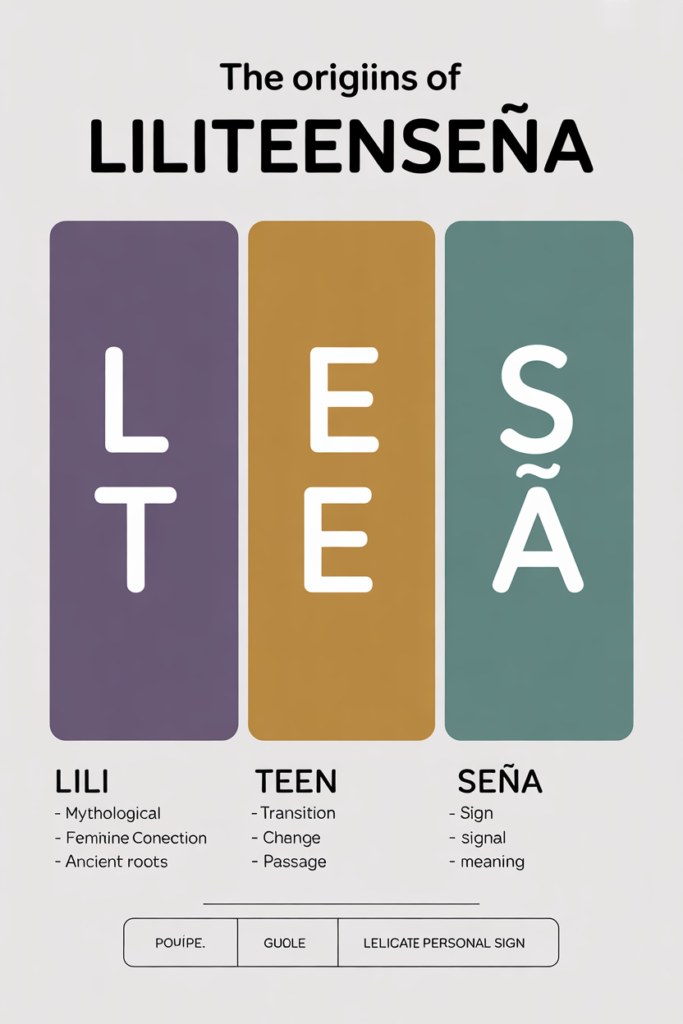
The origins of Liliteenseña remain beautifully mysterious. Unlike words with clear etymological roots documented across centuries, this term emerged from the intersection of language communities, digital culture, and creative invention.
The Spanish Connection
The clearest linguistic clue lies in the ending: -seña. In Spanish, "seña" means "sign," "mark," or "signal." This suggests Liliteenseña could translate to "the delicate sign" or "personal symbol." Breaking down the structure reveals three components: Lili (soft, feminine, name-like quality), -teen (possibly denoting transition or youth), and -seña (sign, mark, signal). Combined, it creates an impression of "a gentle, personal sign" or "a youthful message."
The phonetic flow—lee-lee-teen-SEN-yah—carries a melodic, almost lyrical quality that makes it memorable and pleasant to speak aloud. This Spanish foundation gives Liliteenseña immediate resonance in Romance language communities while remaining accessible to English speakers through its intuitive structure.
The Lilith Connection
The prefix "Lili-" echoes names from ancient mythology—particularly Lilith, a figure associated with independence, mystery, and feminine power in Jewish folklore. This connection gives Liliteenseña an almost mythical quality, as if the word itself carries ancient wisdom. Whether intentional or coincidental, this mythological resonance adds layers to its meaning. Lilith represents autonomy, the refusal to be defined by others, and the power of self-determination—themes that align perfectly with how modern users employ Liliteenseña as a marker of personal identity.
Born in Digital Spaces
Some linguists argue "Liliteenseña" is a constructed term, born from fantasy writing communities exploring invented languages, online storytelling platforms where unique vocabulary signals belonging, creative username evolution, and digital art movements that value symbolic communication. It developed organically, gaining meaning through use rather than formal definition. This bottom-up linguistic evolution mirrors how internet culture has birthed other symbolic terms—words that feel immediately meaningful even when they lack dictionary entries.
How Is Liliteenseña Used Today?
Liliteenseña has carved out unique spaces in modern culture. From creative writing to social media, people use this term to express concepts that traditional vocabulary can't quite capture.
In Storytelling and Literature
Writers embrace Liliteenseña as a powerful narrative device that adds mystique without requiring explanation. In fantasy novels, it might appear as a mystical symbol or prophecy marker that adds world-building depth. Poets use it as a metaphor for personal truth, creating emotional resonance without literal explanation. Spiritual fiction writers employ it as markers of transformation or divine messages, enhancing thematic exploration.
For example: "She discovered the Liliteenseña etched into the ancient door—a symbol only she could understand, left by someone who knew she'd come." Or in poetry: "Every ending carries its own Liliteenseña, a hidden message about what comes next, visible only to those willing to look closely."
The term works beautifully across genres because authors appreciate that Liliteenseña doesn't need lengthy explanation—readers intuitively grasp its significance through context.
On Social Media Platforms
On Instagram, TikTok, and Twitter, users adopt "Liliteenseña" to describe personal transformation moments. Someone might post a photo of a new tattoo with the caption: "This is my Liliteenseña—marking the day I chose myself." Others use it for symbolic representations of identity: "Finding your Liliteenseña means finding your truth."
Visual artists pair the term with their work to convey complex inner states that words alone can't express. The hashtag #liliteenseña has grown steadily, particularly among creative communities, spiritual seekers, and artists exploring symbolic language. This usage provides a sense of belonging—using the term signals membership in a community that values depth, symbolism, and intentional self-expression.
Also Read: Jememôtre: The Complete Guide to Understanding Its Cultural Significance and Modern Impact
In Visual Arts and Design
Visual artists use Liliteenseña as collection titles for gallery exhibitions exploring identity, such as "The Liliteenseña Series: Signs of Inner Worlds." Some embed it as a symbolic signature—a personal mark in their work, like a painter's unique brushstroke pattern. Designers have created jewelry pieces called "Liliteenseña pendants" featuring personalized symbolic engravings, and clothing lines use the term as conceptual anchoring for streetwear that explores identity themes.
The term translates beautifully into visual language because it lacks rigid definition. One artist might represent Liliteenseña as geometric patterns, another as organic flowing forms, and a third as stark minimalist marks. This flexibility makes it endlessly adaptable to different artistic visions.
How to Use Liliteenseña in Your Work
Want to incorporate Liliteenseña into your creative projects? Here are practical ways to use this symbolic term effectively.
As a Metaphor: Use it to represent turning points or revelations. "That conversation became my Liliteenseña—the moment everything shifted and I finally understood what I'd been searching for." This works perfectly for memoirs, personal essays, reflective writing, and blog posts about personal growth.
As a Symbolic Object: Create a tangible sign in your narrative that carries weight beyond its physical form. The carved Liliteenseña glowed faintly in the moonlight, guiding her forward through the forest. She didn't know who left it or why, but she trusted its message." This approach suits fantasy novels, adventure stories, mystical fiction, and young adult narratives.
As a Personal Identifier: Define your creative signature or artistic philosophy. "My art explores the Liliteenseña of modern identity—how we signal who we are in a world of curated personas and filtered realities." This works beautifully in artist statements, portfolio descriptions, brand messaging, and creative business bios.
As a community hashtag, build connections around the concept. Use #liliteenseña on social posts about personal growth journeys, symbolic art projects exploring identity, creative transformations, and artistic evolution. This connects you with others exploring similar themes and helps build an engaged audience around authentic, symbolic content.
Why Is Liliteenseña Becoming Popular?
Liliteenseña's rise reflects a broader cultural shift toward symbolic, intentional self-expression. In an era of curated identities, social media personas, and digital self-presentation, people crave language that captures nuance beyond what traditional vocabulary offers.
Traditional words often fall short when describing the complexity of modern identity—we're no longer just our jobs, families, or locations. They struggle with symbolic personal journeys where transformation isn't always linear or easily explained. They can't quite capture the intersection of inner and outer selves or the gap between who we are and who we present. And they fail at artistic expression beyond literal meaning, where some truths can't be stated directly.
Liliteenseña fills this gap perfectly—it's mysterious enough to intrigue, flexible enough to adapt, and poetic enough to resonate emotionally. It gives language to experiences we all recognize but struggle to name.
The term's aesthetic appeal matters too. It sounds ancient yet modern—timeless but contemporary, like discovering something old that feels fresh. It's familiar yet exotic—accessible to English speakers but carrying foreign mystique. And it's poetic yet meaningful—beautiful to say aloud while carrying substantial symbolic weight.
This duality makes it shareable, memorable, and perfect for the visual, symbolic culture of platforms like Instagram, TikTok, and Pinterest. People don't just understand it—they feel it. That emotional resonance transforms vocabulary into cultural movement.
In a world increasingly dominated by algorithmic content and AI-generated text, Liliteenseña represents something authentically human: the need to create personal meaning, mark our transformations, and signal our identities in ways that resist commodification.
Frequently Asked Questions
Is "Liliteenseña" a real word?
"Liliteenseña" isn't in traditional dictionaries like Merriam-Webster or Oxford, but it's widely used in creative communities, digital spaces, and artistic contexts. It's a constructed term that's gained cultural meaning through organic use—similar to how internet-born words like "ghosting" eventually entered mainstream vocabulary. Its realness comes from shared understanding rather than institutional validation.
How do you pronounce "Leliteenseña"?
Pronunciation: lee-lee-teen-SEN-yah. Break it down: Li-li-teen-se-ña. The emphasis falls on "SEN." The final "ña" has a soft "ny" sound, like the "ñ" in "mañana." Practice saying it slowly, then speed up as you become comfortable with the flow.
Can I use Liliteenseña in professional writing?
Yes, but with appropriate context. It works well in creative writing, artistic statements, personal branding, and content for creative industries. For academic or formal business writing, provide a brief explanation when first using the term: "...what I call a 'Liliteenseña'—a personal symbolic marker that..." This introduces the concept while maintaining a professional tone.
What's the plural of Liliteenseña?
Most users treat it as either singular or uncountable ("the Liliteenseña" or "my Liliteenseña"), similar to abstract concepts like "serendipity." If you need a plural form, "Liliteenseñas" follows standard Spanish pluralization rules and appears occasionally in artistic contexts discussing multiple signs or symbols.
Final Thoughts
Liliteenseña represents more than a word—it's a movement toward symbolic, intentional self-expression in an age of digital personas and curated identities. Whether you're a writer seeking fresh vocabulary, an artist exploring symbolic language, or someone searching for words to describe your inner world, this term offers a poetic bridge between what you feel and what you show.
Its power lies in its openness. Liliteenseña doesn't tell you what to think or feel—it invites you to discover your own meaning, mark your own transformations, and signal your identity in ways that feel authentic to you.