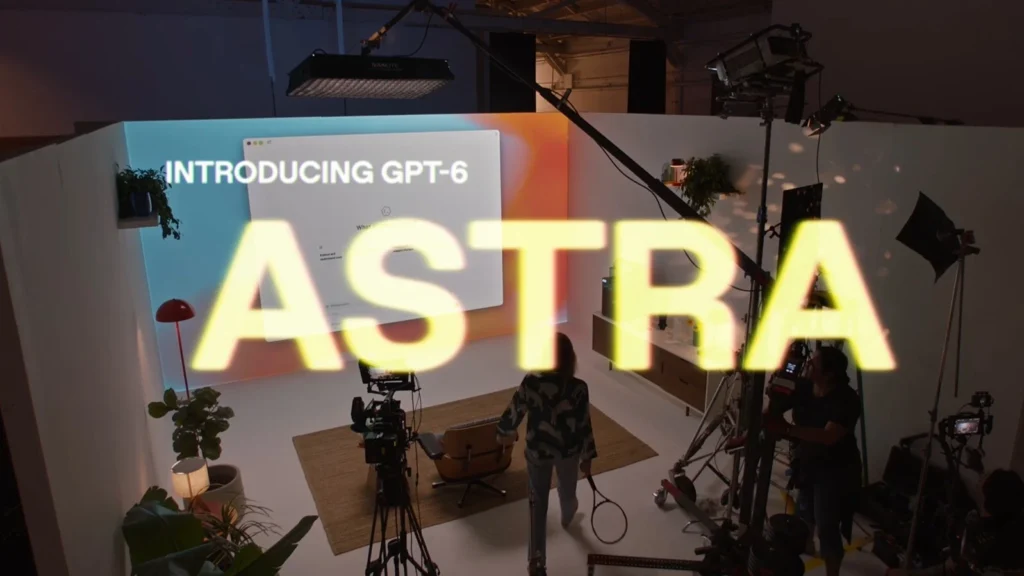
For the past three years, frontier AI advancements have been largely focused on improvements in text prompting. The GPT-6 Astra released by OpenAI on September 3, 2026, represents a fundamental break from this trend. Whereas the company has previously framed successive GPT iterations as more capable chatbots, OpenAI is now positioning its work as an autonomous digital worker - capable of navigating operating systems, directly manipulating software and executing end-to-end professional workflows with minimal human oversight.
The improvements are reflected in the headline metrics, as captured on OpenAI's official GPT-6 Astra launch page. Astra achieves a 72.6% accuracy on OSWorld 2.0, OpenAI's benchmark for real-world computer use tasks, completing them in roughly 47% less time than its predecessor, GPT-5.6 Sol. It achieves 95.9% accuracy on BenchCAD, OpenAI's 3D reconstruction benchmark, and 97.6% accuracy on FrontierMath Tier 4. Moreover, it is the first OpenAI model to pass the "Critical" cybersecurity threshold in the company's Preparedness Framework, an accomplishment that comes with mixed feelings at the executive level. For enterprise CTOs and automation engineers looking to identify their priorities for the next decade, Astra represents far more than an evolutionary improvement in language models.
Also Read Claude AI Model Vulnerabilities Explained
What Is GPT-6 Astra?
GPT-6 Astra is OpenAI's flagship model that is designed around the use of agentic workflows rather than the standard chat interactions. Whereas an ordinary chat interface waits for a prompt and then responds with text, Astra is capable of performing more interactive tasks. It can navigate UIs as one would do in real life: it can read on a screen, examine UI elements, move a computer cursor, click windows and buttons, and type in keyboards.
This allows Astra to operate in browsers, terminal consoles, office applications, enterprise systems such as CRM, where it can fill out forms, update databases, generate documents, and perform quality-assurance checks, without having to go through a process of human instructions. OpenAI claims the model is capable of tracking context throughout large, multi-step processes, allowing it to complete tasks that earlier iterations would have been unable to finish due to losing context after a round of interactions or in a middle of a task.
Key Feature Upgrades: What Changes with Astra?
1. Digital worker & OS-level automation
Astra is designed to operate in actual software environments rather than describe how to use them. OpenAI's own benchmarks show it navigating browsers, spreadsheet programs, presentation programs, and terminal tools to perform administrative and development tasks in order to fill out a Form 1040, run frontend QA on a website, or format a legal document, for instance. On OSWorld 2.0, Astra scored 72.6% at about 40 minutes a task, compared to 65.7% at about 75 minutes for GPT-5.6 Sol. That's a significant improvement in both accuracy and speed for anyone considering the ROI of automation.
2. Spatial reasoning & 3D/CAD generation
Astra's spatial reasoning is one of its more unusual capabilities as a language model. OpenAI shows it modeling a house in Blender and exporting it as a walkable scene in Unreal Engine 5, and separately performing PCB layout in KiCad by placing components on a board and routing copper to make it manufacturable. On BenchCAD, a task to reconstruct 3D objects from multi-view images by generating CAD code, Astra scores 95.9%, outperforming GPT-5.6 Sol (83.3%) and the figure reported by OpenAI for Claude Fable 5.1 (84.3%).
3. Scientific computing & deep research
Astra marries scientific reasoning with computer use, allowing it to take effect within specialized research software to inspect data, assess sequencing quality, and determine what to investigate next instead of merely describing an analysis. OpenAI also credits an internal version of Astra with contributing to new results on the gaps between prime numbers work that has been partially formalized using the Lean theorem prover and published in the PrimeGaps186 repository, though the company is explicit that some of these results depend on stated input axioms and are not unconditional proofs.
Benchmark Analysis: How GPT-6 Astra Compares
Across almost every category where OpenAI publishes its results, Astra either excels or is close behind its main external competitor, Anthropic's Claude Fable 5.1. However, Fable 5.1 still outperforms Astra for Humanity's Last Exam (with tools) and Artificial Analysis Intelligence Index, OpenAI's own comparison table shows.
| Evaluation Domain | Benchmark | GPT-6 Astra | Key Comparison | Enterprise Relevance |
|---|---|---|---|---|
| System operations | OSWorld 2.0 | 72.6% | GPT-5.6 Sol: 65.7% | Completes desktop workflows in ~47% less time |
| 3D modeling & CAD | BenchCAD | 95.9% | Claude Fable 5.1: 84.3% | Higher geometric accuracy for CAD/3D prototyping |
| Cybersecurity | ExploitBench | 100.0% | GPT-5.6 Sol: 78.5% | First model to hit OpenAI's "Critical" cyber threshold |
| Advanced math | FrontierMath Tier 4 | 97.6% | GPT-5.6 Sol: 83.0% | Handles graduate-level mathematical reasoning |
| Tool-based reasoning | Humanity's Last Exam (w/ tools) | 57.2% | Claude Fable 5.1: 65.0% | One of the few areas Astra trails its main rival |
Enterprise Security & Preparedness Framework
Astra’s achieved a 100 percent score on ExploitBench, which according to the GPT-6 Astra system card, an internal OpenAI system for assessing catastrophic risk capabilities, means that OpenAI has classified it as “Critical” within its Preparedness Framework. In practice, this means that Astra is capable of identifying and developing working exploits against previously unknown weaknesses and systems with no specific guidance from humans.
OpenAI has chosen to gate the most sensitive capabilities of the model, rather than remove them entirely. The publicly available version of Astra is trained to deny advanced offensive tasks, such as writing proof-of-concept exploits, while still supporting defensive work such as secure code review and patching. More permissive access to Astra's cybersecurity capabilities is being rolled out gradually to vetted organizations through OpenAI's Daybreak program. OpenAI also claims that it has increased Astra's resistance to jailbreak attempts and expanded the context available to its internal monitoring systems as part of this release.
API Availability, Models, and Pricing
GPT-6 Astra is launching for a restricted group of firms on September 3, 2026, and it will become accessible to the ChatGPT Plus, Pro, Business, and Enterprise, OpenAI API, Microsoft Azure, and AWS Bedrock accounts in the days that follow. Enterprise administrators may turn Astra on for their business, but it will be inactive by default at launch. Pro, Business, and Enterprise users will also have access to a version known as GPT-6 Astra Pro.
| Parameter | Standard Tier | Fast Mode |
|---|---|---|
| API model ID | gpt-6-astra | gpt-6-astra (fast mode) |
| Input tokens | $10.00 / 1M tokens | 2x standard price |
| Output tokens | $50.00 / 1M tokens | 2x standard price |
| Speed | Baseline | Up to 2x faster |
| Context window | Tested up to ~1M tokens (OpenAI MRCR v2 long-context benchmark) | Same |
There are different rates for cache reads and writes. Astra offers Zero Data Retention for qualified API customers, which is essential for regulated industries as well as businesses with specific data-handling demands.
Frequently Asked Questions
How does GPT-6 Astra differ from GPT-5.6 Sol?
GPT-5.6 Sol is primarily based on a high-speed, high-quality text generation and reasoning model. Astra has native PC-use capabilities in addition to the aforementioned possibilities, allowing it to work in operating systems, desktop and web apps, and carry out more complex tasks with fewer restrictions.
What is the context window for GPT-6 Astra?
Even though OpenAI did not publish any official figures in the launch post, its long-context benchmarks test the model at up to one million tokens, scoring 96.3% on the OpenAI MRCR v2 8-needle benchmark in the 512K-1M range.
Can enterprise users restrict data retention when deploying Astra?
Yes. OpenAI states that Astra supports Zero Data Retention for eligible API customers, alongside enterprise admin controls for enabling or restricting the model at the workspace level.
How does GPT-6 Astra handle the security risks of autonomous computer operation?
Astra is deployed under OpenAI's Preparedness Framework, which requires additional safeguards given the model's "Critical" cybersecurity classification. These include refusal training on advanced offensive cyber tasks, system-level monitoring of model reasoning and actions, and staged access to more permissive capabilities through vetted programs like OpenAI Daybreak.
What kinds of design and engineering tasks can Astra handle?
OpenAI has demonstrated Astra reconstructing 3D objects from multi-view images, modeling a house in Blender and converting it into a walkable Unreal Engine 5 scene, and performing PCB layout in KiCad. Its 95.9% BenchCAD score reflects strong performance on CAD-style geometric reconstruction tasks specifically, though OpenAI has not published a list of natively supported file export formats.
Sources & Further Reading
- OpenAI GPT-6 Astra: A new generation of intelligence (official launch page, benchmarks, pricing)
- OpenAI GPT-6 Astra System Card (Preparedness Framework classification, safety details)
- OpenAI Ten advances in mathematics and theoretical computer science
- GitHub openai/PrimeGaps186 (prime gaps proof repository)
Benchmark figures, pricing, and availability details in this article are sourced from OpenAI's official GPT-6 Astra launch page and system card. Figures may be updated as OpenAI's rollout continues.