The AI world is changing at an incredible speed, and what was once seen as an experiment has now become the basis for how people and businesses operate. The recent AI updates, ranging from smarter productivity tools to powerful multimodal models, are essentially changing the way work is done, decisions are taken, and products are created.
In this edition of AI Updates news, we highlight the least to most amazing breakthroughs that you cannot afford to miss: from NotebookLM doing your slides automatically to Perplexity creating apps with AI and an intense Grok 4.1 vs. GPT-5.1 competition that is propelling the whole sector. In fact, these artificial intelligence updates are a perfect indication of the future of AI technology in 2025, whether you are a tech enthusiast, a founder, or a working professional.
Agentic AI Updates: The Rise of Autonomous AI Agents
One of the most important AI 2025 news trends is the rise of agentic AI. Agentic systems, unlike traditional AI tools that respond to individual prompts, are essentially designed to work with a certain level of independence. These models are capable of planning and carrying out multi-step tasks as well as making decisions based on goals, not just instructions.
Agentic AI systems are not just tools; they are more like digital employees. They are able to dissect goals into smaller steps, choose the appropriate tools, keep track of results, and change their actions if something alters. This strategy is a major transition in the AI automation trends, thus, the need for continuous human supervision is lowered.
Industries are already showing the early examples of use cases. Research synthesis, software development, customer support automation, and internal workflow management are the areas where autonomous AI agents are undergoing the trials. In business environments, this means the execution of tasks will be quicker, operational costs will be reduced, and decision-making will be enhanced by the power of next-generation AI models.
It is a move from 'AI that answers questions' to 'AI that gets work done' with agentic AI reaching its full potential. This development might be the next era of artificial intelligence.
NotebookLM Makes Slides Automatically: Productivity Reinvented
NotebookLM from Google is no longer simply a research assistant. One of the most talked-about AI updates this week to NotebookLM app is its newly acquired capability to convert notes into well-organized presentations automatically. By a single gesture, users are able to convert unpolished research into decorated slides, including proper sequencing and extracting the key points.
For students, teachers, and workers, this feature is worth a fortune in time that would otherwise be spent on manual formatting and content organizing. Rather than copying the text, designing the pages, and rewriting the bullet points, users may choose to work on their ideas and thus create more value.
This update makes NotebookLM ai one of the top AI productivity tools in the world. It is an example of how generative AI tools for productivity are slowly but surely doing away with the tasks that were very time-consuming but of low-value. What is more, it is an indication of AI gradually becoming an integral part of our everyday workflows instead of just a novelty.
As companies are progressively embracing AI, the case of NotebookLM being able to show how small feature updates can lead to large efficiency gains, is a perfect example.
Perplexity Builds Apps Using AI: From Idea to Product Faster
Another surprise development in the latest AI changes is the decision of Perplexity ai to expand its feature to app invention. With this new feature, Perplexity uses AI to make applications, thus enabling users to have a working program from a mere idea in a very short time.
This power dramatically cuts out the technical requirements that usually hinder a startup, a solo founder, or a non-technical creator. The result is that one only needs to specify what he wants, and AI will come up with the code structure without him having to engage a development team or spend months on making a prototype.
This change is indicative of a larger movement whereby AI tools are gradually taking over tasks that used to be done manually. A recent update from Perplexity is a good example of how multimodal AI models are not just a means for search and knowledge retrieval, but can lead to real-world creation. Essentially, the upgrade suggests that AI is becoming a co-creator rather than just a support tool.
As a result, innovators will have the opportunity to experiment much faster, save on costs, and have the capability to test their ideas at an incredible pace. The year 2025 is such that the gap between idea and product is the shortest it has ever been.
Grok 4.1 vs GPT-5.1: The Model War Heats Up
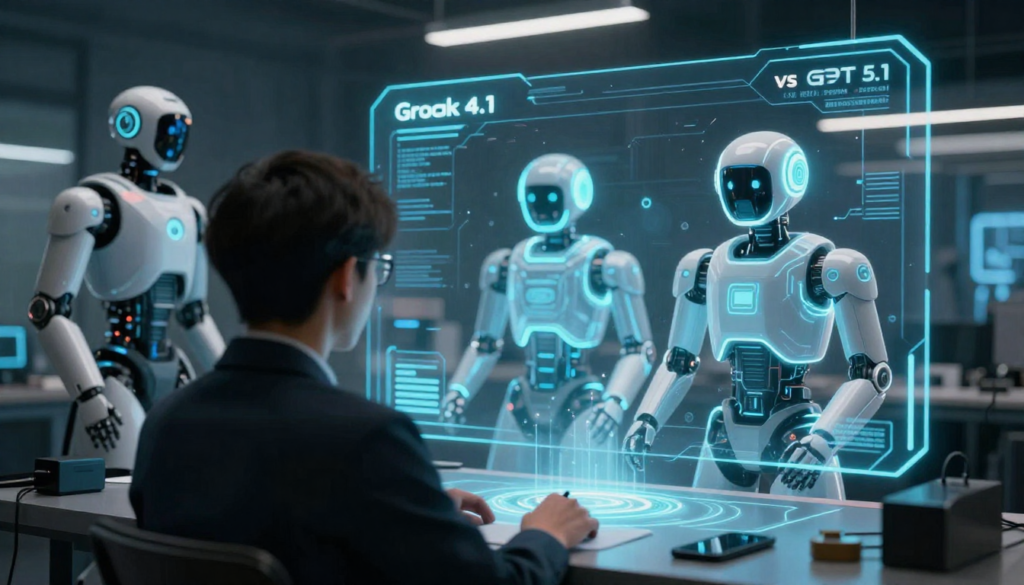
The argument about Grok 4.1 vs GPT-5.1 is literally everywhere on the "AI updates you can't miss" lists. The two models are the last fighters in the differences of the future of AI philosophies, as the competition is getting fierce.
xAI's Grok 4.1 is equipped with main features of real-time reasoning and social data comprehension. Contextual awareness, immediate responses, and the skill to bind analysis to the unfolding information are what make Grok so strong. Therefore, Grok becomes extremely useful, for instance, in any application that is dependent on live data and fast-paced conversations.
Meanwhile, OpenAI's GPT-5.1 is centered more on enhanced reasoning, improved multimodal capabilities, and better context handling. It is a device capable of handling complex tasks requiring deep thinking, creativity, and enterprise-level stability.
That is to say, the contest between Grok 4.1 and GPT-5.1 is one of the reasons why the competition in the AI sector is leading to a faster innovation pace. It is not a matter of single dominant approach, but rather models optimized for different needs. In essence, these two systems are the coming of AI technology— more capable, more specialized, and more impactful.
Meta SAM3: Video Intelligence Enters a New Era
Meta has again surprised the AI community with the release of Meta SAM3 AI, an advanced vision model that can accurately segment the objects in the video. The technology, often referred to as "Meta SAM3 video magic," enables the objects to be identified and tracked in real-time visually across the intricate scenes.
This means a lot of new possibilities and the use of Meta SAM3 in video editing, content moderation, augmented reality, and immersive experiences. Creators can isolate the elements within the videos more easily, and businesses can automate the visual analysis at a large scale.
As AI video generation and editing tools become more popular, Meta SAM3 is a great example of how multimodal AI models are changing creative and industrial workflows. It is a proof that the future of AI is not only text and images but also increasingly visual, interactive, and dynamic.
What These AI Updates Mean for the Future
When looking at these AI updates today collectively, they point out a very distinct direction for the industry. Artificial intelligence is progressively becoming more independent, more reachable to any user, and more deeply stuffed in the routine work of the day. The new AI innovations of 2025, ranging from agentic AI use cases to app-building and advanced video intelligence, are basically made to empower the users and not to overwhelm them.
As a consequence, enterprises have to think over the question of work organization anew, i.e., who—or what—will do it. Creators and professionals, on the other hand, take this as an opportunity to raise their productivity and creativity with the help of new tools. The ones who comprehend and implement these technologies at the earliest will create a competitive advantage that will last.
It is no longer optional to keep abreast with AI updates latest you cannot afford to miss; rather, it is a strategic necessity in a rapidly changing digital environment.
Final Thoughts
The speed at which AI news is coming out in 2025 is quite overwhelming but still helps to clarify one thing: a new era with intelligent systems is coming. The way these innovations, like NotebookLM changing productivity, Perplexity reinventing app development, Meta progressing video intelligence, or the continued Grok 4.1 vs. GPT-5.1 battle, to mention just a few, are impacting our work, creation, and thinking processes is phenomenal.
As the next chapter of AI technology is being written, those with a continuous desire to learn, flexibility, and a good understanding of the situation will be the ones to make the most of it. More AI news, detailed comparisons, and future-tool insights will be coming your way, so keep cooperating.