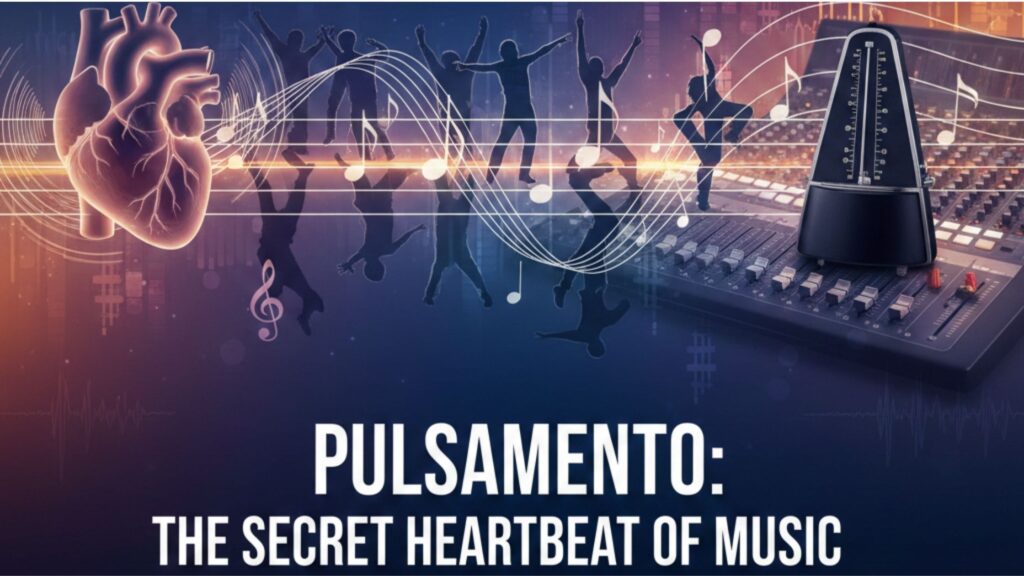
Have you ever wondered why you can’t help but tap your foot when your favorite song comes on? Or why a slow song makes you feel relaxed while a fast one makes you want to jump around? The answer is something called pulsamento.
In this guide, we’re going to look at what pulsamento is, how it works, and why it’s the most important part of any song—from the oldest drum beats to the latest hits on the radio.
Quick Facts: The Basics
- Definition: Pulsamento is the steady, "invisible" beat that stays the same throughout a song.
- The Heartbeat: It’s like a heartbeat for music. It’s always there, even if you don't hear a loud drum.
- Pulse vs. Rhythm: The pulse is the steady beat (like a clock ticking); the rhythm is the pattern of notes that plays on top of it.
- Your Body: Humans are "hard-wired" to find the pulse. It’s why we dance!
What Exactly Is Pulsamento?
Imagine you are looking at a piece of graph paper. The straight lines that are spaced perfectly apart are the pulsamento. Now, imagine drawing a cool picture on that paper. Your drawing can go anywhere, but the grid helps you keep everything in the right spot.
In music, pulsamento is that grid. It is the steady, repeating pulse that keeps a song from turning into a mess of noise. While the singer might change their speed or the guitar might play a fancy solo, the pulsamento stays the same. It’s the "timing" that helps everyone in a band stay together.
Why Do Our Bodies Love a Pulse?
Humans are "rhythm machines." Think about it: your heart beats in a rhythm, you breathe in a rhythm, and even the way you walk is a steady 1-2-1-2 pulse.
Because our bodies already have their own "clocks," we naturally look for a beat in the music we hear. Scientists call this entrainment. This is a fancy word for when your brain locks onto a beat. Once your brain finds the pulsamento, it helps you:
- Guess what’s coming next: You know exactly when the next beat will hit.
- Move in time: This is how you can clap along with thousands of other people at a concert and stay perfectly in sync.
Pulsamento vs. Rhythm: What’s the Difference?
Many people think pulse and rhythm are the same thing, but they are actually partners. Here is an easy way to remember the difference:
a) Pulsamento (The Pulse): This is like the ticking of a clock. It never changes speed unless the whole song speeds up. It’s the constant thump-thump-thump.
b) Rhythm: This is the actual melody or words you hear. Rhythm can be fast, slow, or "off-beat."
The Secret of Syncopation: Have you ever heard a beat that feels a little "jumpy"? That is called syncopation. It happens when a musician plays a note between the beats of the pulsamento. It feels exciting because your brain expects the beat on the "grid," but the musician surprises you by playing around it!
Pulsamento in Your Favorite Music
Different types of music use the pulse in different ways:
1. Classical Music
In a big orchestra, there isn't usually a drum set. Instead, a conductor stands at the front. They move their baton to show the musicians the pulsamento. This ensures that 50 different people all play the exact same beat at the same time.
2. Jazz: The Art of the "Swing"
Jazz musicians are masters of the pulse. They keep the beat steady (usually with a bass guitar or a cymbal), but they play their notes just a tiny bit early or late. This is what gives Jazz that "cool," relaxed feeling known as swing.
3. Dance and EDM
In Electronic Dance Music (EDM), the pulsamento is the star of the show! It is usually a very loud, heavy "kick drum" that hits on every beat. This is designed to make it as easy as possible for your body to lock onto the rhythm and start dancing.
How the Beat Changes Your Mood
The speed of the pulsamento is called tempo. The tempo is like a remote control for your emotions:
a) Slow Pulse (60 Beats Per Minute): This is about the same speed as a resting heartbeat. It makes us feel calm, sad, or thoughtful.
b) Fast Pulse (120+ Beats Per Minute): This is like your heart after you’ve been running. It makes us feel excited, happy, or full of energy.
How to Practice Your "Internal Clock"
Every great musician has a strong sense of pulsamento. They don't just hear the beat; they feel it in their bones. Most musicians practice with a metronome, which is a little device (or an app) that makes a "click" sound at a perfectly steady speed.
If you want to improve your musical skills, try this: Put on your favorite song and try to find the "One" (the first beat of every measure). Once you find the pulsamento, everything else in the music starts to make sense!
Frequently Asked Questions (FAQ
1. Is pulsamento the same as the "Beat"?
Yes! In most cases, when people talk about "the beat" of a song, they are talking about the pulsamento.
2. Why do some songs feel like they don't have a beat?
Some music (like "ambient" music or some movie soundtracks) is designed to be "beat-less." This makes the music feel like it is floating, which can be very relaxing or even a little bit spooky!
3. Does the pulsamento ever change in a song?
Sometimes a song will speed up (called an accelerando) or slow down (called a ritardando). When this happens, the "heartbeat" of the song changes, and your body will naturally speed up or slow down with it.
4. Can I have a rhythm without a pulse?
You can, but it’s very hard for people to dance to or follow. Without a pulse, music feels like people just talking at random. The pulse is what turns noise into a song.
Conclusion
Pulsamento is the invisible "glue" that holds all music together. It’s the heartbeat that connects the performer to the listener and the sound to the body. Whether you are listening to a symphony or a hip-hop track, the pulsamento is what makes you feel the music.
Next time you listen to a song, try to ignore the words for a second and just feel that steady "thump." That’s the pulsamento, and it’s the reason music brings us all to life!