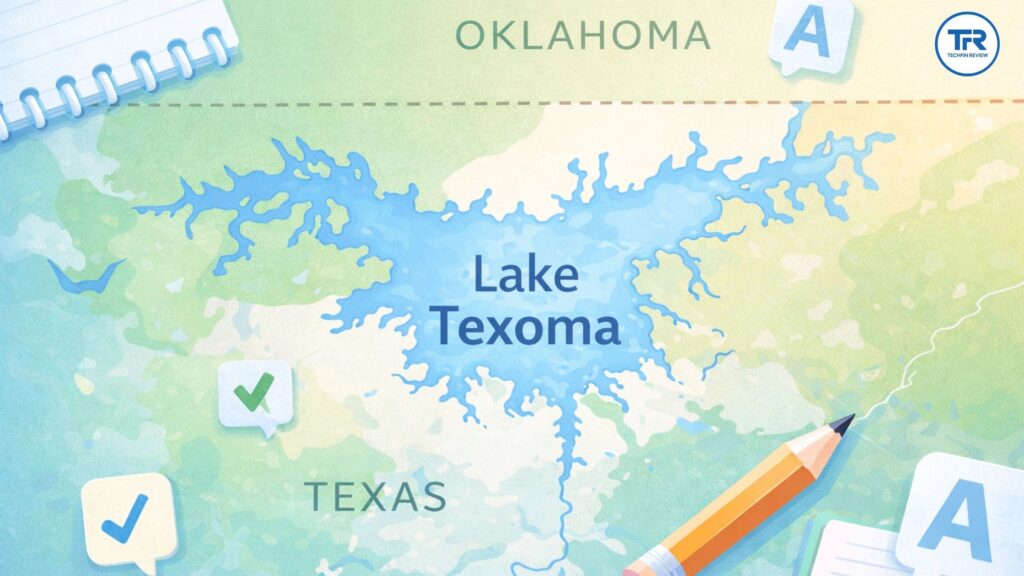
You’re writing a school report about the best vacation spots in the southern United States. You confidently type lake texoma into your essay. Suddenly, your computer flashes a blue underline. It looks like a mistake, but you are not sure why. You pause and wonder whether it actually matters.
The reason is simple: lake texoma should be capitalized every single time you write it. But why does a lake need capital letters at all?
This confusion is common among students because capitalization rules can feel arbitrary. In reality, they follow a clear logic tied to how language organizes ideas. When you understand that logic, grammar becomes predictable rather than frustrating.
In this guide, you will learn what proper nouns are, how the M.I.N.T.S. rule works, why teachers and style guides insist on capitalization, and why even search engines care about your shift key. By the end, you will never second-guess this rule again.
What Is a Proper Noun?
Before focusing on lakes, it helps to understand nouns in general.
A noun names a person, place, thing, or idea. Words like city, teacher, and lake are all nouns. These are called common nouns because they refer to general things rather than specific ones.
A proper noun names a specific person, place, or thing. Proper nouns always begin with capital letters because they identify something unique. Examples include LeBron James, Paris, and Mount Everest.
A helpful way to think about it is the name rule. A name is a name, regardless of whether it belongs to a person or a place. A body of water can have a name just as clearly as a human does.
| Common Noun (Lowercase) | Proper Noun (Capitalized) |
|---|---|
| a big lake | Lake Texoma |
| a long river | Red River |
| a tall dam | Denison Dam |
If you write the lake, readers do not know which one you mean. When you write Lake Texoma, you point to a single, exact location on a map. That specificity is why capitalization matters.
Why Lake Texoma Should Be Capitalized (≈250 words)
To understand why lake texoma should be capitalized, break the name into parts.
The word lake tells us the category. It describes what kind of thing it is. The word Texoma identifies which lake it is. When combined, Lake Texoma becomes one complete name.
This rule is not based on opinion. Major writing authorities agree on it. Both the AP Stylebook and the Chicago Manual of Style, which guide journalists, editors, and academics, state that named geographic features must be capitalized. Lakes, rivers, mountains, and parks all follow this rule.
A simple test can help you remember. Imagine calling your friend by a general word instead of their name. If you say boy, no one knows who you mean. If you say John, everyone understands. In this comparison, lake is like boy, and Lake Texoma is like John.
Capitalization signals importance and clarity. It tells the reader that you are referring to one specific place, not a random body of water. That clarity is the main reason teachers correct this mistake so often.
Using the M.I.N.T.S. Rule
A popular memory trick for middle school students is the M.I.N.T.S. rule. It helps you remember when to use capital letters.
- M – Months: January, February, March
- I – I: The word I is always capitalized
- N – Names of places: This is why lake texoma should be capitalized
- T – Titles: Books, movies, and songs
- S – Start of a sentence
Lake Texoma fits perfectly under “Names of places.” It is a named geographic location, so it earns capital letters every time.
When you apply this rule, capitalization stops being a guessing game. You simply check whether the word fits one of the M.I.N.T.S. categories.
Common Mistakes: When NOT to Capitalize
Knowing when not to capitalize is just as important.
The “the” trap is the most common mistake. If you write, I went to the lake with my family, the word lake stays lowercase because it is not a name. It describes a general place.
Another advanced rule involves plural names. If you are talking about more than one named lake, you still capitalize the names:
- Correct: Lakes Texoma and Lewisville are popular in Texas.
- Incorrect: lakes texoma and lewisville are popular.
Practice spotting the difference:
- Wrong: We studied lake Texoma in geography class.
- Right: We studied Lake Texoma in geography class.
Context determines capitalization. If it is a name, capitalize it. If it is general, do not.
Fun Facts for Your Report
Adding facts makes your writing more interesting and more informative.
The Name
The name Texoma combines Texas and Oklahoma. The lake sits directly on the border between the two states, which makes the name easy to remember.
The Size
Lake Texoma covers approximately 89,000 acres. That makes it one of the largest reservoirs in the United States. With that much water and shoreline, it definitely qualifies as a landmark worth naming properly.
The History
The lake was created by the construction of Denison Dam during World War II. The project helped control flooding and provide power, making it important to regional development.
Including facts like these strengthens reports and essays. They show research effort and help readers connect grammar rules to real-world places.
Why This Matters for Your Grades and the Internet
In school, teachers look at capitalization to see whether students understand how ideas are organized. Correct capitalization shows control over basic writing mechanics.
Online, accuracy matters as well. When people search for Lake Texoma, search engines look for pages that use the correct spelling and capitalization. Writing names properly improves clarity for both humans and algorithms.
Grammar is not just about rules. It is about communication.
Conclusion and Quick Quiz
To summarize, lake texoma should be capitalized because it is a specific, unique place. The word lake becomes part of a proper noun when it is joined with Texoma. This rule follows standard grammar guides and helps writing stay clear and professional.
Quick Quiz
- Is lake capitalized when it stands alone?
No - Is Texoma a proper noun?
Yes - How do you correctly write the name of the lake on the border?
Lake Texoma
If you can answer these, you have mastered the rule.