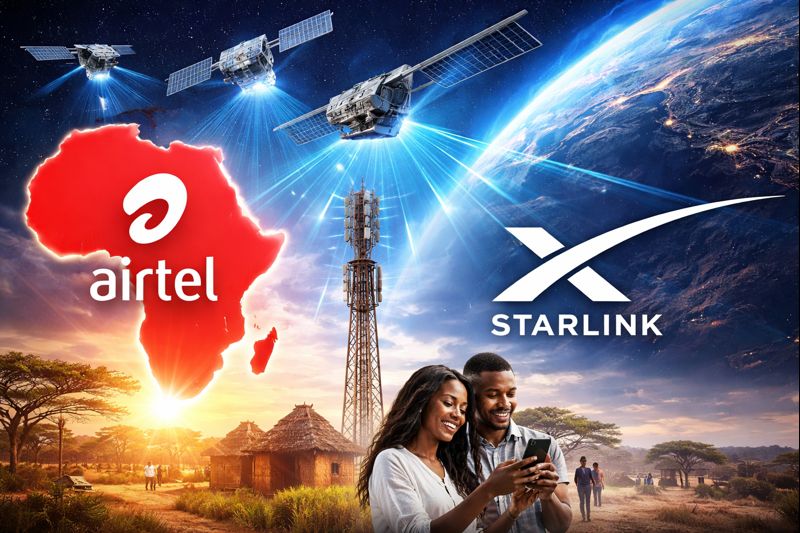
Airtel Africa has made a big move to change how people get online digitally all over the continent by teaming up with SpaceX's Starlink to bring Direct-to-Cell satellite connectivity to all 14 markets where it operates, i.e., South Africa, etc. The service will be up and running around 2026, and it is aimed at bringing mobile coverage to the countryside, out-of-the-way places, and the underprivileged areas where there is hardly any or no telecom infrastructure at all.
Airtel Africa’s change is a big deal in a major way among about 174 million users. It is one of the boldest moves that tries to reduce the digital gap in Africa. The company and its partner want to bring reliable mobile communication to those communities that have been left out of internet access for a long time by connecting satellite technology straight to the mobile networks.
Starlink, SpaceX, and Elon Musk: Driving Next-Generation Connectivity
In order to grasp the significance of this collaboration, it is first required to understand the technology and the future image Starlink is about.
Starlink is a satellite internet service that is based on a large network of low-Earth orbit (LEO) satellites kept in various orbits around Earth, aiming to provide broadband with low latency and high speed to unserved or underserved areas of the world, and it is a project of the space company SpaceX, which was also founded by Elon Musk. The dozens of LEO satellites on almost polar orbits are the main elements of a new broadband network for Earth worldwide using the Direct-to-Cell technology.
As opposed to the satellite internet systems that are currently in use but not widely known, and which generally rely on some few special hardware that are not common, Starlink's Direct-to-Cell technology enables satellites to directly talk with the most recent smartphones that are new-5G compatible; thus, there is no need for cell towers around, although a minimum job station is there. This technology indirectly allows the mobile satellite to install a ground base station to link the internet, and up to 100-200 users outdoors can share since most of the area is in villages where minimum job stations and ground infrastructure are difficult or expensive.
Elon Musk, who is most famous for his leadership at SpaceX and Tesla, has never stopped pointing out the role that a world internet of global communicability would play. Starlink is one of the main features of the Elon Musk global tech vision to bring broadband across the tropics or to far and unconnected people, and thus the education, trade, nutrition, and communication sectors reap the fruits and enjoy free access to new solutions through communication technology.
The Direct-to-Cell breakthrough is a huge technological leap making it possible for satellite systems to become mobile systems with co-mobile facilities inherent to conventional terrestrial systems instead of substituting them.
What the Airtel–Starlink Partnership Delivers
Airtel Africa, through this partnership, intends to expand mobile network coverage capabilities that are far-reaching and are not limited by standard infrastructures. Key Elements of the Partnership
- Direct-to-Cell Coverage Across 14 Markets: A local presence with a direct-to-cell network in 14 markets will be established by Airtel Africa using Starlink’s innovative satellite technology in the regions it works in, such as South Africa, Nigeria, Kenya, Uganda, and other major African markets.
- Service Launch Expected in 2026: A staged rollout will allow the use of mainly text messaging and a few data services on compatible smartphones, which will be the case in the districts that do not have mobile network coverage and in those that have very minimal network coverage.
- Advanced Satellite Technology: The equipment is designed to work with newer generation satellites that can offer data speeds considerably higher than the ones achieved by previous satellite internet solutions.
- Extensive Reach via LEO Satellite Constellation: The low-Earth orbit satellite network is the reason why there continues to be a connection; thus, it is still possible to have an uninterrupted internet connection even in extremely isolated locations.
This move makes Airtel Africa the first mobile operator on the continent to officially use Starlink’s Direct-to-Cell technology as a commercial application, thereby setting a new standard for mobile services in Africa.
Why Airtel Africa and Starlink Joined Forces
The collaboration is a result of mutual goals of both the institutions, which were very clear from the start.
1. Bridging the Connectivity Gap
Even today, millions of people in Africa do not have access to reliable mobile internet. Most of these people live in rural and geographically challenging areas. Constructing regular mobile towers in these areas is not only expensive but also technically complex. Through the use of satellite technology, Airtel Africa is now able to reach those people who have been left out for the last decades.
2. Strengthening Network Reliability
Satellite connectivity makes mobile networks more reliable as it adds another source of power. In the event of a natural disaster or a failure of infrastructure, services that are based on satellites can be used to keep in touch through messaging, simple data access, and emergency coordination.
3. Advancing Digital Inclusion
The internet is the gateway for anyone to become part of the economic and social systems of the modern world. Through this partnership, sectors such as education, mobile banking, healthcare, and e-commerce, which are the future of the digital economy, will be accessible to more people, who, in turn, will be empowered to participate in the digital economy.
4. Demonstrating Technological Leadership
With Airtel Africa going for the most advanced satellite technology, it is sending a message to the African telecom sector that it is still the leader in innovation. This step is a signal of a long-term commitment to source solutions for the next generation with the view of meeting increasing connectivity demands.
South Africa: Key Benefits and Opportunities
South Africa, which consists of both modern urban areas and large rural areas, can benefit immensely from this.
Major benefits include:
1. Expanded Rural Connectivity
It is anticipated that satellite connectivity will bring the much-needed mobile services to those communities that have always been left out. Such individuals will now have access to messaging and internet connectivity.
2. Economic Empowerment
By having access to connectivity, people will be able to do remote work, participate in online education, start digital businesses, and grow small businesses.
3. Healthcare and Emergency Communication
With satellite connectivity, the communication system will not break even if there is an emergency; thus, a faster response will be possible, and access to the most needed information will be easy.
4. Network Complementarity
The use of satellite services will be more efficient and reliable than before, which will create a more extended coverage area and be of great assistance in solving serious problems facing the network. Besides, the services will not be substituted for each other, but satellites will complement the ground networks.
Broader Impact Across Africa
While South Africa remains the major winner, the impacts of this partnership are felt throughout the continent.
- · Reducing Digital Inequality: The number of people accessing mobile internet services will increase substantially; hence, the digital divide will be narrowed.
- Encouraging Entrepreneurship: Startups, digital platforms, and e-commerce in communities that have been deprived of the middle and hence the internet will be supported by reliable connectivity.
- Supporting Smart Technologies: Networks enabled by satellites can lead the way to the faster implementation of IoT solutions, agri-tech, and smart city initiatives.
- Lower Infrastructure and Environmental Costs: The installation of satellites is less dependent on the lengthy and costly ground installations, which are also environmentally disruptive in the remotest areas.
The agreement between them is a good example of a hybrid network model that merges terrestrial and satellite technologies to provide tough and top-notch-quality connectivity.
Looking Ahead: The Future of African Connectivity
The launch of Airtel Africa's Direct-to-Cell service with Starlink is just the first step of a much bigger change to follow in the African telecommunications industry.
1. Hybrid Networks as the New Standard
Tomorrow's network will most likely be a hybrid of fiber, mobile towers, and satellites to both extend the coverage area and ensure the network is always available.
2. Expansion of Services
Services may extend to voice calling, video communication, and full broadband access as technology gets more sophisticated.
3. Digital Growth Across Sectors
Improved connectivity, as the basis for long-term socioeconomic development, will permeate education, health care, government services, and commerce sectors.
Therefore, the partnership that combines a reliable mobile network with cutting-edge satellite technology is the most powerful way to guarantee that no one will be left out of the digital revolution due to their geographical location.
Conclusion: A Connectivity Revolution for Africa
The collaboration between Airtel Africa and Starlink is a significant change-pivot moment for telecommunication across the whole of Africa. Enabled by satellite technology, Airtel Africa will be able to take mobile services to the areas that were left out and thus will facilitate digital inclusion, economic growth, and technological progress.
South Africa, as well as the whole African continent, will be able to enjoy the benefits of better mobile coverage, easier access to the necessary digital services, and new possibilities for innovation. As the implementation is scheduled for 2026, free mobile connectivity all over Africa is almost there.
This partnership is a powerful statement of the potential of innovation, technology, and well-planned partnerships to change the African digital future landscape—turning the mobile connection into a shared reality rather than a limited privilege.