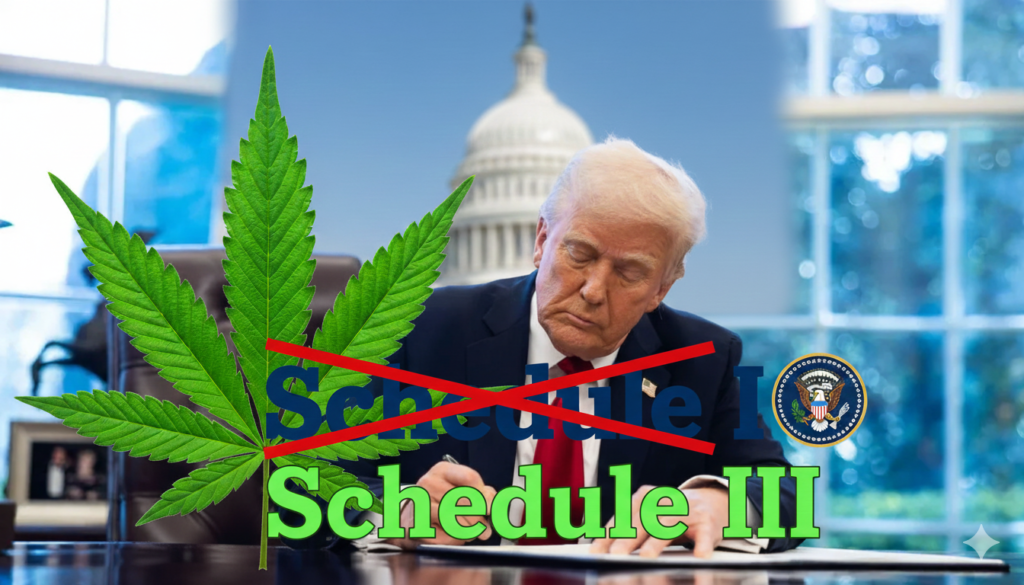
On December 18, 2024, in a historic executive order action, President Donald Trump ordered federal authorities to reclassify marijuana from Schedule I to Schedule III under the Controlled Substances Act. This marks the most significant adjustment to federal cannabis policy in decades and carries heavy implications for businesses, researchers, and patients throughout America.
While this isn't federal legalization and doesn't impact recreational marijuana laws, the reclassification could have the effect of fundamentally reshaping the cannabis industry through tax relief, expanded medical research, and improved banking access. Here's everything you need to know about what Trump's order does, what it doesn't do, and what happens next.
What Trump's Executive Order Does
President Trump ordered Attorney General Pam Bondi to speed up the rescheduling process which was halted in Biden’s administration and was already at a deadlock for a long time. The Biden team began this process back in October 2022, but it was still not done during the transition period.
While signing the document Trump made it clear that reclassification would open the doors for marijuana-related medical research thus allowing scientists to determine its pros, cons and future use for treatment. The key word in the order is “expedite” which signals the administration’s determination to fast-track a very slow bureaucratic process that usually takes years.
Understanding Schedule I vs. Schedule III
In order to appreciate the significance of this situation, it is necessary to get a grasp on how the federal government classifies controlled substances.
Schedule I (the present status) is the category with the highest restrictions, which is only for the substances that do not have any medical use and are very likely to be abused. At present, marijuana is classified together with heroin, LSD, and methamphetamines, and is subject to the same strict federal restrictions that include almost complete prohibition on research, highest penalties for criminal offenses, and huge taxes that are hard for businesses to bear.
Schedule III (the proposed new status) consists of substances that might cause moderate to low dependence and are accepted for medical use. Other prescription drugs in Schedule III include ketamine, anabolic steroids, and Tylenol with codeine. This classification accepts that marijuana has legitimate medical uses, yet it still keeps some federal controls over it.
The difference here is very important: marijuana is still a federally controlled substance in Schedule III, but it is switching to a more lenient regulatory framework.
What WILL Change: The Major Impacts
1. Huge Tax Cuts for Cannabis Firms
Undoubtedly the greatest immediate repercussion has to do with IRS Section 280E, a tax code from 1982 that does not allow legal cannabis companies to write off even basic expenses like rent, salaries, marketing, and utilities. Consequently, the taxes paid by these companies can be as high as 70% or more, in contrast to the normal 21% corporate tax rate.
The moment cannabis was reassigned to Schedule III, it could be much more advantageous tax-wise as companies would be allowed to write off daily business expenses. Preliminary estimations made by experts in the industry suggest that this change could result in a whopping tax relief of thousands of millions dollars annually for the whole industry, while the tax of a single company may go down by 20-40%. The reinvestment of the saved money will be done in the areas of growth, quality, pricing competition, and manpower.
2. Medical Research Expansion and New Possibilities
For over thirty years, Schedule I limitations have been the main reason for the slow progress of marijuana research. A reclassification to Schedule III would bring the FDA to the point of easily approving and monitoring such research, which will be a way for scientists to hold clinical trials, work out the medical advantages for diseases like chronic pain and PTSD, setting dosing standards, and producing medicines of the highest purity.
The big pharmaceutical companies that have been shying away from cannabis because of its Schedule I categorization can now bring their money into the development of FDA-approved cannabis medicines. This, in turn, might pave the way for treatments covered by health insurance and being part of mainstream medicine.
3. Cannabis Banking and Finance Access
Cannabis companies usually transact in cash mainly because they can't get banking services as banks are afraid of federal prosecution. Schedule III goes a long way in limiting these fears of bank compliance, which in turn gives banks the confidence to open business accounts, do credit card processing, make loans, and provide merchant services.
What might be the most dramatic effect is the fact that the institutional investors who have been hesitant to come into the market due to compliance issues can now get in.
What WILL NOT Change: Critical Clarifications
Not Federal Legalization
Marijuana is still classified as a federal drug that cannot be legally used. It is still considered illegal to use Schedule III drugs. No one is allowed to have cannabis if they do not have a prescription or if their state has not legalized it, and marijuana-related cases can still be handled by federal law enforcement agencies who can arrest and prosecute offenders.
No Impact on Recreational Marijuana
The presidential decree clearly speaks of medical marijuana and research. It does not, however, prohibit the use of recreational marijuana and does not make state recreational programs non-existent or resolve the federal-state conflict over recreational marijuana. The 24 states that have legalized recreational use continue to operate according to their laws, but the federal prohibition still applies.
No Criminal Justice Reform
The advocates consider this as a big disappointment. The order from Trump's administration does not include any pardons, sentence reductions, provisions for expungement, or alteration of federal sentencing guidelines. Lots of people, thousands, are getting locked up in federal prisons just because of cannabis, and even more, people have their criminal records that make it hard for them to get jobs or housing.
Employment Drug Testing Complications
The National Transportation Safety Board issued a warning that the reclassification of cannabis to Schedule III might result in the prohibition of drug testing for safety-sensitive transportation positions according to the existing regulations. Moreover, industry groups want regulatory exceptions that would allow preserving the testing authority for commercial drivers, pilots, and other safety-critical roles.
Timeline: How Long Will This Take?
Even though Trump has given a directive to "expedite," it will not be done overnight. The Drug Enforcement Administration has to go through a complicated process that involves a scientific evaluation, consultations with multiple agencies, public comments (42,000+ comments have already been received), publication of the final rule, and possible litigation that could challenge the process.
Realistic Timeline: The majority of the experts see a wait of about 2-3 years or even more until the final implementation. The best case scenario speculates the end by mid-to-late 2026, however, looking back at history, longer periods are probably going to be the norm for such cases. Therefore, businesses and researchers should prepare for changes but not expect them to happen right away.
Industry Reactions and Market Impact
In a surprising turn of events, cannabis stocks fell in the beginning even though the news was at least partly good. The concern of investors is that becoming a Schedule III drug will allow big pharmaceutical companies to come to the market with better resources than the smaller companies and, thus, will dominate the competition. Additionally, the long waiting time will mean that these benefits will not be available for years when the new competition could arrive earlier.
Nevertheless, the majority of analysts have a positive long-term view of the situation. The fundamental improvements—tax relief, banking access and legitimacy—are expected to bring about great growth once they are in place. The market for legal cannabis is predicted to increase from about $30 billion in 2024 to $50-70 billion by 2030.
What Happens Next
In the short term, AG Pam Bondi will work with DEA top management to set the timeframes for the reclassification and to decide on the priorities of the process. The DEA will not stop processing the public comments and will also keep on doing its thing with the federal agencies. It is the time for cannabis companies to start considering their tax approaches, checking the possibilities of banking, and determining their compliance requirements.
In the mid-term, the DEA will have to announce its final ruling in the Federal Register, probably in about 6 to 18 months. Groups against it may resort to legal action intending to prolong or block the implementation.
In the long run, the change of classification of the cannabis industry will have a major impact in terms of mergers, entry of pharmaceutical companies, and the research-driven product innovation that might lead to integration with the mainstream healthcare.
The Bottom Line
Trump's executive order is a turning point in the federal cannabis policy, as it now acknowledges the medical value of marijuana and gives essential backing to the legal cannabis industry. The tax saving by itself could amount to billions yearly, but research openings are the ones that will lead to a better understanding of marijuana's medical usage.
But this does not mean full legalization. Marijuana continues to be federally banned, recreational use is still not allowed, and the people who have suffered the most from the war on drugs are not even being considered for help. The transition will last for several years, and there will be new hurdles, especially in cases of pharma rivalry and the complexity of regulations that will have to be faced.
For businesses, researchers, and patients, the reclassification of Schedule III will be a major boost. But the complete marijuana reform, which will include criminal justice provisions and the legalization of recreational use, is still a matter of future action from Congress and the administration.
As this transformation proceeds in the next few years, the players involved should monitor the DEA updates closely, get ready for changes in the regulations, and continue to push for reforms that cover industry requirements and social justice issues.